
Disconnected from the larger landscape and events unfolding now, and looking at it from an individual perspective where the power or the quality of the tools (products, goods) that we buy, and for which the ‘bang for buck’ factor matters more, ‘Buy European’ can indeed sound like a political slogan.
Looking at it more broadly and through the lens of a longer timeframe, it can also be solid advice. It is ultimately not just a choice between European or other, it is also a choice of who would you rather have handling your data at scale, analyzing it at scale, dictating your security, influencing behavior at scale and most importantly influencing the long term economic outcomes of your family, country and continent.
So the question is, would you rather have that be a company in an increasingly unhinged ecosystem that wants to steal everyone elses lunch money now, or one in a system that has some rules and guiding principles it still adheres to?
Some might argue that Europe is too heavily regulated, and that having regulators stand too much in between a company and it’s users is a bad thing for innovation. But is it so? Is regulation really doing that, or is it just slowing down the rate at which some companies want to make massive profits without contraints and without rules? Currently it seems to be the latter. I’m not saying that the existing rules are good. Heck, some should be better and some shouldn’t even exist. But they are in place for a reason and to an extent they might prevent us from turning ourselves into powder, a thing that European countries have successfully done repeatedly for centuries, and from which seemingly they have learned something. Maybe, just maybe, it’s (arguably) a bit healthier than living permanently in a cut-throat zero-sum type of arrangement.
Some might also argue that European tech products are not as good, but if we look at companies like Spotify, SAP, ASML, Ericsson, ARM, Qt, JetBrains, Docker, GitLab, Blender, Klarna, Adyen, Unity, Elastic, Wise, Bolt, Revolut, DeepL, Stripe, Miro, Framer etc. (and that’s just to name a few in the tech sector) we might broaden our perspective. We have more than one example of European companies bought out by overseas companies. So if they aren’t good enough that means that someone has a preety big appetite for buying out low-performing companies with weak products. One thing that European products most obviously don’t have though, is the great PR that overseas products have, but that stems from the different cultural perspective Europe has. While here we might prioritize proof before visibility, in the US it’s mostly the other way around.
There is also the debate around the fact that Europe is investing too little in innovation in comparison with overseas tech conglomerates that are investing billions, and had a 30 year head-start, but everyone has to start somewhere, and if we don’t want to end up being a digital colony entirely, the best time to start is now. Sure, the $30 million investment in an AI initiative announced by the French president recently might sound like chump change, but that’s only because we live in a world that in the past 5 years alone, started to deal increasingly in hundreds of billions or trillions. It’s a mistake to think that $30 million is still not a lot of money. We’re just hit daily with too many tweets and reels flaunting unbelievably large numbers so maybe we might have just gotten desensitized to what is still actually a lot of money, or maybe we’re just so off the path we can’t even see the trail markers anymore.
Even though Google is now spending that amount on CAPEX every 90 minutes, it’s easy to forget they started out with $100k day-one money and roughly $1 million in seed funding shortly after, so maybe it’s not a realistic comparison to make. Also, DeepSeek the Chinese AI research lab started out with roughly $1.4 million.
Irrespective of the greater context though, what you can be sure of, is that if it’s not a regulator throttling your access to a tool for ‘your own protection’, then it’s definitely a private company doing it, and they are not doing it for your protection they are doing it for their own benefit. Of course, your benefit will be accounted for, but only marginally and to the minimum extent that’s sufficient to keep you paying.
Destruction as much as creativity seem to be two very defining traits of our species and the ultra-capitalist variety of our species have an ingrained disdain for regulation because it prevents them from making a lot of money no matter the means or damage. While we can acknowledge that not all regulations are useful, having none or little for the sake of unlimited profit and justifying it as ‘innovation’, is definitely not the way to go, unless we want to live in a Wall-e-esque kind of future.
The debate between regulation and deregulation has been a long-standing and quite central debate at the top levels, in democratic countries with market-based economies, and while we might not have the perfect moral, legal, economic or social clarity around the topic as individuals, we can all make choices based on multiple approaches andbased on our different priorites.
The (seemingly) political approach – you buy it just because it is made in Europe, or to feel like a good citizen – which in the current context is not a bad choice, and from time to time it doesn’t hurt to be a good citizen in all aspects of our lives, otherwise we’d be all living in an anarchy;
The pragmatic approach – you buy it because it fits your particular preference for the cost/features combo no matter where it’s made – again, not a bad choice if it helps your particular situation;
The purely technical approach – you buy it because it is the absolute best of the best technically and that’s what you need (most of the time overseas products are better) – not a bad approach and anyone can spend their dollar however they wish as long as they account for the consequences it has;
The philosophical (ethical) approach – you buy from a company that aligns with your values, such as not being a fan of turning society in a no-rules turbo-capitalist dystopia;
The geographical approach – you buy local if you can source it, if not, go reginal, national, continental, then global – this can also be a strategy, but it generally works easier for needs that are more tangible in nature such as physical goods, but it can also apply to tech;
A mix of all of the above? – which I would like to believe most sensible people would do;
No matter the underlying ecosystem, corporations are corporations and we already know it from history that most will either align with power, or some become the power themselves and would do absolutely anything to bring in the dollar, given no constraints at all (we have hystorical examples for that too).
Ultimately it is not beliefs, values, goals, or political stance that make a difference long-term, but the choice made. What and how we all choose dictates where we’ll be in 10-20-50 years, and what you chose with your wallet now, will definitely be reality tomorrow.
This is a pretty thought provoking topic which can turn into a very long debate that can have many facets, nevertheless it is still a topic with no definitive answer, something i’d argue is heavily context based.
‘Buy European’ or not, is a personal choice in the end. What no one can escape though no matter what, is human nature and game-theory.
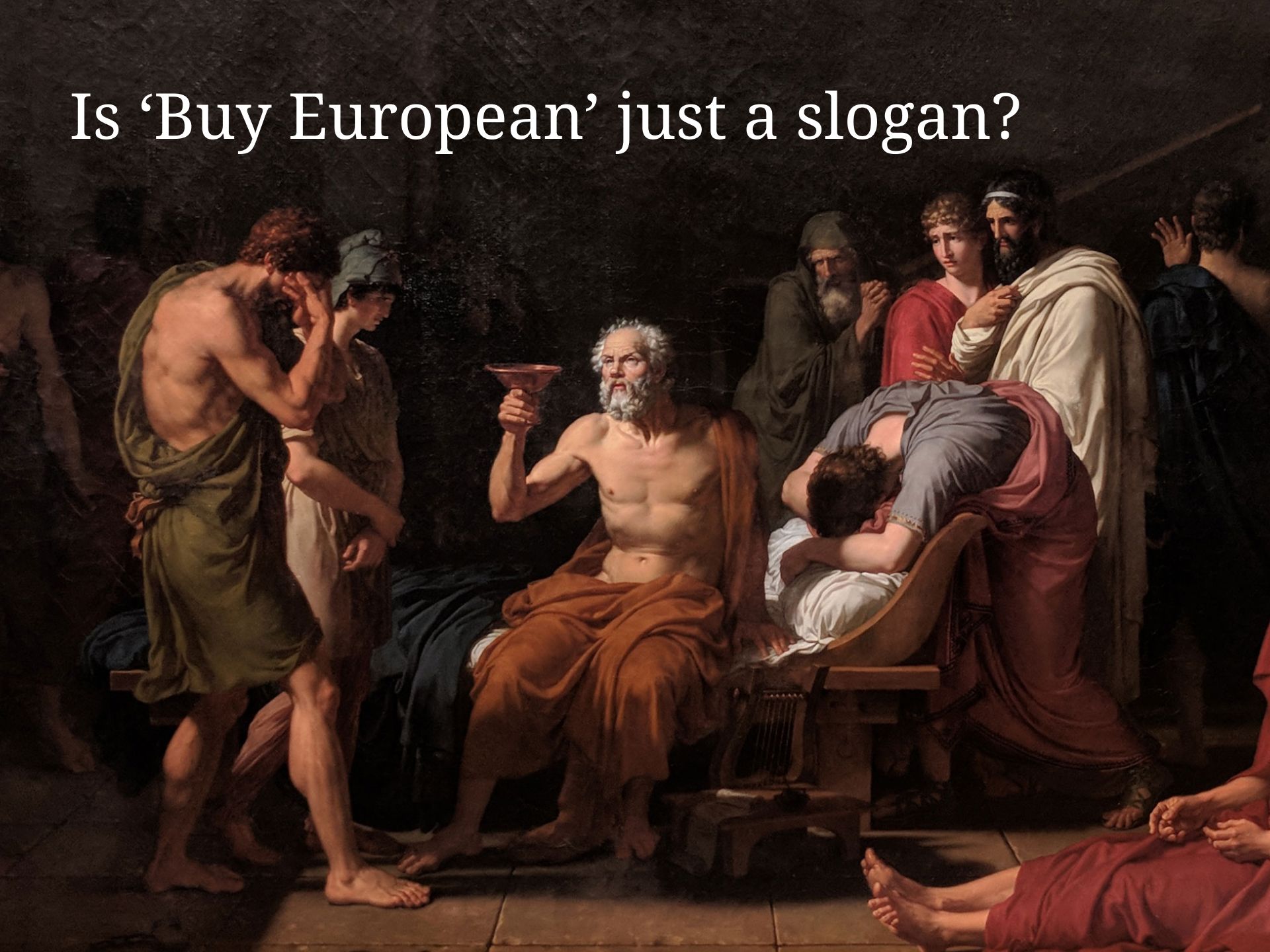
Artwork: The death of Socrates • François Xavier Fabre